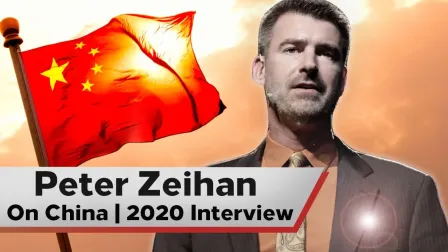

Peter’s latest newletter series is his favourite subject - the decline of the world.
It’s called 'The Crisis List' and his first country is Russia.
Any guesses which countries he will do next?
I’m thinking Brazil.
Full Newsletter and sign up : https://zeihan.com/life-after-trump-part-vi-the-crisis-list-russia/
Peter's twitter: @PeterZeihan
After sketching out what was intended to be the final installment of this series, I realized the world was in a lot more trouble than I had thought. So, the “Crisis List” installment is going to be a whole mini-series of its own. Let’s begin with the country that has experienced the greatest surge in influence under former President Trump: Russia.
Throughout history the Russians have always held a weak hand. Their geography and climate make the basics of life – food and security – devilishly difficult. Their lack of navigable rivers demands huge rafts of artificial infrastructure, but that costs money that Russia’s brutal winters and vast distances simply don’t generate. Painfully short summers limit food production per acre forcing Russians to spread out to farm the necessary calories. Russia has pretty much always held the record for the fewest people per square mile among the world’s populated zones.
Add in wide-open borders that are wretched at blocking marauding Swedes, Germans, Mongols and even Poles, and Russia lives in the worst of pickles. An expensive, low-reward land. Scattered populations who quite reasonably hope that life might be better elsewhere. Looming threats of invasion.
Surviving here requires a big army (at a big cost in economic and cultural terms) and a massive intelligence system finely attuned to every whisper of dissent and every footfall at Russia’s edges.
The Americans created globalization to bribe up an alliance to contain the Soviets, but it also generated an unexpected boon for Moscow. In banding all of Russia’s traditional foes (and then some) into a single coalition, the Americans removed any strategic initiative from all their new allies. The Russians only needed to worry about the Americans. No one else. From 1946 to the Soviet Union’s very end, no one invaded Russia. Such bliss had never occurred. The Russians may have been contained but they were left alone, giving them 45 years to attempt to make their country work.
In the end it wasn’t enough time. While Soviet engineering was indeed impressive compared to what happened under the tsars, there just weren’t enough resources – human, material, or economic – to fund everything. Developing lands as crappy as Russia’s is expensive. Fighting a global Cold War is expensive.
After the Soviet Union collapsed, Russia’s leaderships have been forced to make a series of ever-more-damning decisions. What to fund versus what to leave to rot? Food production? The rail lines? The air force? The missile forces? Oil production? The educational system? Everything comes at a cost, and Russia’s resources are limited. With the Russian demography among the world’s fastest aging and arguably the world’s most unhealthy, those resources are shrinking by the year. Everything – and I mean everything – has had its funding cut. Everything but one thing: those mission-critical intelligence services.
And so it is primarily through the intelligence services that the Russians engage the world. The Kremlin realizes every other measure of their power from military force to energy exports to high-tech work is living on borrowed time.
The Russians have good reason to be worried, but to this point they’ve been able to avoid catastrophe. That’s as much due to luck with the Americans as anything else.
The Russians found W Bush intimidating as it was very clear back in 2001 he planned to massively expand the NATO alliance to Russia’s west, and amp up U.S. military tech to prevent any possibility of a Russian revival. But then came 9/11. The Russian transport system became integral to fighting the war in Afghanistan. Bullet dodged. Breath sighed.